
Twenty-six antibodies, a claim to millions
Amgen discovered that an antibody sitting on a small patch of the PCSK9 protein could lower LDL cholesterol, and it turned that insight into Repatha (evolocumab). Its patents disclosed the amino acid sequences of 26 antibodies that worked. But the claims did not stop at those 26. They covered every antibody, discovered or not, that binds the same patch and blocks the same interaction.
Sanofi and Regeneron built Praluent (alirocumab), a different antibody with a different sequence that does the same job. Amgen sued. The fight ended on May 18, 2023, when a unanimous Supreme Court held the claims invalid for lack of enablement. The record showed a “vast” genus, the district court spoke of “at least millions of candidates,” and the Court noted that the immune system may be able to generate up to a quintillion distinct antibodies.
The decision is usually summarised in one line: “The more one claims, the more one must enable.” The more useful lesson for industry is the reason behind it. A generic method for finding antibodies cannot support a claim to everything that method might find, because what it finds is open-ended and unpredictable. This article works through that reasoning at the level of the amino acids themselves.
1. What an antibody patent really protects
An IgG antibody is two identical heavy chains and two identical light chains, about 1,300 amino acids in total, folded into a Y. Almost all of it is scaffold. The part that decides what the antibody binds is six short loops at each arm tip, the complementarity-determining regions (CDRs): three on the heavy chain (H1–H3) and three on the light chain (L1–L3).
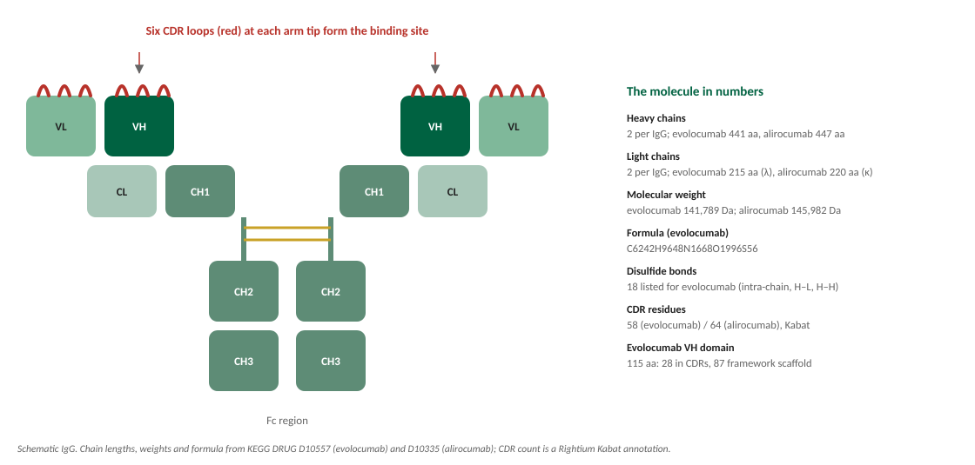
That anatomy explains why a sequence-defined antibody claim is the safest patent in biotechnology. Write down the six CDRs, or the full variable domains, and you have described a specific molecule that a skilled person can make. The DNA encoding a known sequence can be synthesised and expressed in a standard cell line, so written description and enablement are satisfied together. The open questions become novelty and non-obviousness: is this sequence new, and would a skilled person have arrived at it from the prior art?
What a sequence does not tell you is how the molecule folds and what it will bind. At trial an Amgen expert conceded that converting an antibody’s amino acid sequence into a known three-dimensional structure was not yet possible. Another acknowledged that substitutions can affect function, so each variant would have to be tested. That gap between sequence and function is where the case was decided.
2. Two drugs, one function, two unrelated sequences
The clearest evidence of the gap is the two commercial products. Both bind PCSK9 and block its interaction with the LDL receptor. Their binding loops look almost nothing alike.
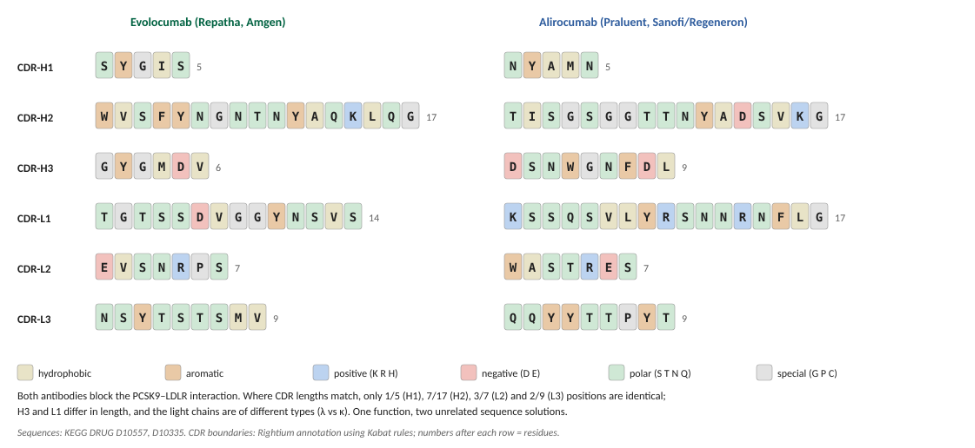
Across the four CDRs of equal length, only 13 of 38 positions match. CDR-H3, usually the most important loop for binding, is six residues in Repatha (GYGMDV) and nine in Praluent (DSNWGNFDL). The light chains belong to different families, lambda against kappa. Here is the full variable heavy domain of each, with the Kabat CDRs set apart:
Evolocumab VH EVQLVQSGAEVKKPGASVKVSCKASGYTLT [SYGIS] WVRQAPGQGLEWMG
[WVSFYNGNTNYAQKLQG] RGTMTTDPSTSTAYMELRSLRSDDTAVYYCAR [GYGMDV] WGQGTTVTVSS
Alirocumab VH EVQLVESGGGLVQPGGSLRLSCAASGFTFN [NYAMN] WVRQAPGKGLDWVS
[TISGSGGTTNYADSVKG] RFIISRDSSKHTLYLQMNSLRAEDTAVYYCAK [DSNWGNFDL] WGRGTLVTVSS
Sequences from KEGG DRUG D10557 and D10335. Bracketed CDRs are a Rightium annotation using Kabat rules; other numbering schemes (IMGT, Chothia) draw the loop edges slightly differently.
For patent purposes this is the whole problem in miniature. A claim defined by function captures both molecules. A specification that teaches only the first gives no way to predict the second; it was found by separate work. That is why the claims needed more disclosure than 26 examples could supply.
3. From molecules to an address: how Amgen claimed
Amgen’s claims described antibodies by where they bind and what they do, not by what they are. PCSK9 is 692 amino acids long. The claims fixed on 15 of them, a “sweet spot” on the catalytic domain where the LDL receptor docks.
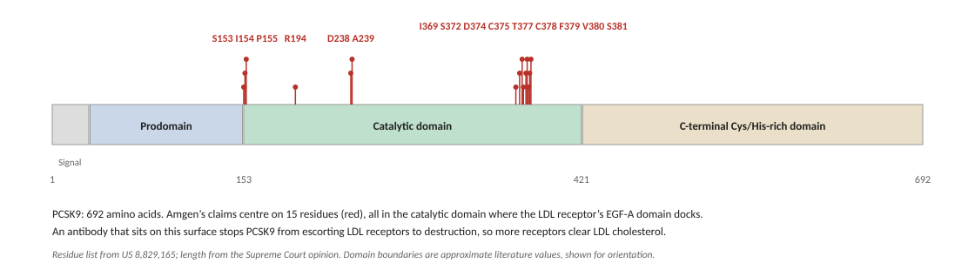
The asserted claims followed one template, varied in breadth. As the Federal Circuit described them:
- ’165 patent, claim 1: an isolated monoclonal antibody that binds at least one of S153, I154, P155, R194, D238, A239, I369, S372, D374, C375, T377, C378, F379, V380 or S381 of PCSK9, and blocks PCSK9 from binding the LDL receptor.
- ’165 patent, claim 19: the same, binding at least two of those residues.
- ’165 patent, claim 29: a pharmaceutical composition form, with the antibody blocking PCSK9–LDLR binding by at least 80%.
- ’741 patent, claims 1 and 7: an antibody whose epitope includes residue 237 or 238 of PCSK9 and which blocks LDL-receptor binding, with claim 7 adding a “functional epitope” limitation.
Every limitation is a test result, not a structure. “Binds residue X” is confirmed by a binding or structural assay; “blocks” by a functional assay. Neither tells a skilled person which sequences to make. The record also showed how far the genus reached beyond the examples. The claims covered antibodies binding up to 16 of the listed residues, yet no disclosed antibody bound more than nine, and three claimed residues were not bound by any example. The examples, in the Federal Circuit’s words, “only abide in a corner of the genus.”
4. Why a generic method cannot carry an endless result
Amgen did not argue that its 26 examples alone enabled the claims. It argued that the specification taught two methods for finding the rest:
- The roadmap. Immunise mice that make human antibodies, collect candidates, then test each one in sequence: does it bind PCSK9, does it bind the sweet spot, does it block the LDL receptor?
- Conservative substitution. Start from one of the 26 working antibodies, swap amino acids for others with similar properties, and test whether the variant still works.
The Court called these “little more than two research assignments.” Each is a reliable way to look, but neither predicts what will be found. The Court also used Brenner v. Manson’s phrase for such disclosures: a “hunting license.”
4.1 The arithmetic of “conservative” substitution
Take evolocumab’s 58 CDR residues and count the candidates that a simple substitution strategy opens up.
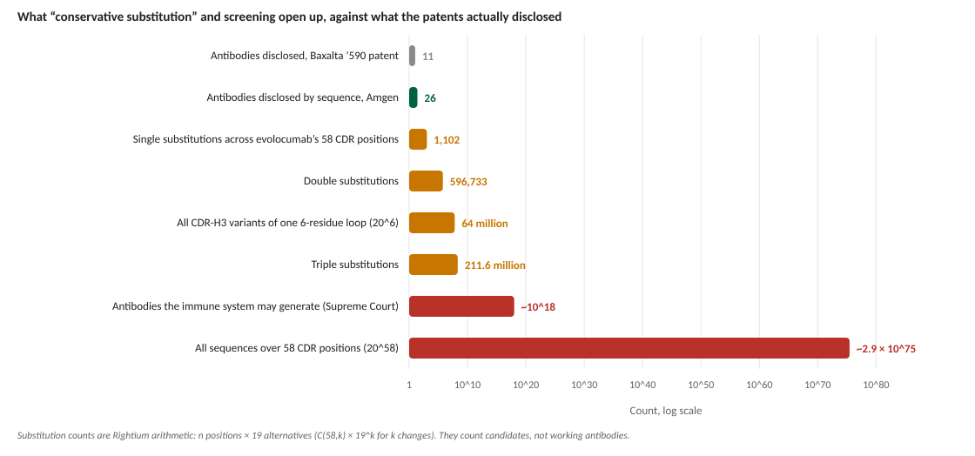
Substitution strategy | Candidates | How calculated |
One change anywhere in the CDRs | 1,102 | 58 positions × 19 alternative amino acids |
Any two changes | 596,733 | C(58,2) × 19² = 1,653 × 361 |
Any three changes | 211,641,304 | C(58,3) × 19³ = 30,856 × 6,859 |
Every sequence of CDR-H3 alone (6 residues) | 64,000,000 | 20⁶ |
Every sequence over all 58 CDR positions | ≈ 2.9 × 10⁷⁵ | 20⁵⁸ |
The Court’s combination lock | ≈ 1.3 × 10¹³⁰ | 100 tumblers × 20 positions = 20¹⁰⁰ |
Rightium arithmetic. The figures count candidate sequences, not working antibodies, and they treat the CDRs only; framework changes add more.
Restricting swaps to “similar” amino acids helps less than it seems. The usual groups are below. Even a single conservative swap can break binding, because a loop’s shape depends on the whole sequence around it.
Group | Residues | Why a ‘similar’ swap can still fail |
Hydrophobic, aliphatic | A, V, L, I, M | Size differences change packing at the binding interface |
Aromatic | F, W, Y | Y has a hydroxyl that F lacks; W is much larger |
Positive | K, R, H | H is only partly charged at body pH; R forms more hydrogen bonds than K |
Negative | D, E | One extra carbon moves the charge by about 1.5 Å |
Polar, uncharged | S, T, N, Q | N and Q can create glycosylation or deamidation sites |
Special | G, P, C | G and P set loop geometry; C can form or break disulfides |
General biochemistry, shown to explain the unpredictability the courts relied on; the groupings are conventional, not taken from the opinion.
4.2 The legal logic
The Court illustrated the problem with a combination lock: 100 tumblers, each with 20 positions. Telling someone to try combinations until one opens is not teaching them how to open it. That maps directly onto a protein. Twenty amino acids per position, across dozens of positions, with the working combinations scattered unpredictably.
The point for practitioners is structural. When the method is generic (immunise, screen, test), each new antibody it yields is a new discovery, not something the patent taught. A claim to all of the method’s results therefore claims discoveries not yet made. That is what the old cases refused:
- O’Reilly v. Morse (1854): Morse could patent his telegraph, but not every use of electromagnetism to print at a distance.
- The Incandescent Lamp Patent (1895): a claim to every fibrous or textile carbon filament failed. Edison had to test some 6,000 materials before finding the bamboo that worked.
- Holland Furniture v. Perkins Glue (1928): a claim to starch glues defined only by how well they performed failed.
The contrast case shows what does work. In Wood v. Underhill (1846), a brick-making recipe that left the user to adjust proportions for different clays was enabled, because the adjustment followed a known principle. Some experimentation is allowed; random search is not. The Court said a specification may call for “a reasonable amount of experimentation,” and need not describe every embodiment if it discloses “some general quality … running through” the class. Amgen’s specification identified no such quality linking sequence to sweet-spot binding.
5. Section 112: the two requirements and how they bite
35 U.S.C. § 112(a) requires that the specification contain “a written description of the invention, and of the manner and process of making and using it, in such full, clear, concise, and exact terms as to enable any person skilled in the art … to make and use the same.” Courts read two separate requirements into that sentence.
Requirement | Question it asks | How it applies to antibody genus claims |
Written description | Did the inventor possess the full claimed genus at filing? (Ariad v. Eli Lilly, en banc 2010) | Needs a representative number of species, or structural features common to the genus, that a skilled person would recognise as the genus. In 2017 the Federal Circuit rejected the “newly characterized antigen” shortcut: describing the target is not describing the antibodies. |
Enablement | Can a skilled person make and use the full scope without unreasonable experimentation? | Amgen: full scope must be enabled, and trial-and-error screening of a vast genus is not reasonable. The Wands factors still frame the analysis. |
Definiteness, § 112(b) | Are the claim’s boundaries reasonably certain? | Functional and epitope terms must be measurable by a defined assay. |
Means-plus-function, § 112(f) | If a claim recites a function without structure, what does it cover? | Only the disclosed structures and their equivalents: narrow, but sometimes defensible. |
The Wands factors (In re Wands, 1988) decide whether the needed experimentation is reasonable: the quantity of experimentation, the guidance given, the working examples, the nature of the invention, the state of the prior art, the skill in the art, the predictability of the art, and the breadth of the claims. For a functional antibody genus they line up badly. The claims are broad, the art is unpredictable, the guidance is a screening protocol, and the examples cover a corner of the genus.
Written description and enablement are separate tests, and an antibody genus usually has to pass both. In Juno Therapeutics v. Kite Pharma (2021), a CAR-T claim to any single-chain antibody fragment binding a target failed on written description alone. That reversed a judgment of about $1.2 billion.
6. What the law looks like since 2023
- Baxalta v. Genentech (Fed. Cir. Sept. 20, 2023). The claims covered any antibody that binds Factor IX/IXa and increases its procoagulant activity, which read on Genentech’s bispecific Hemlibra (emicizumab). The patent disclosed 11 working antibodies, found by routine hybridoma generation and screening, against a genus of millions. The court found the facts “materially indistinguishable” from Amgen and held that “random trial-and-error discovery, without more, constitutes unreasonable experimentation.” It saw “no meaningful difference” between Wands’ “undue” and Amgen’s “unreasonable” experimentation.
- USPTO guidelines (89 Fed. Reg. 1563, Jan. 10, 2024). Examiners continue to apply the Wands factors to all technologies, asking whether the experimentation needed to make and use the full scope is reasonable. Rejections must state the specific reasons and evidence.
- In re Xencor (Fed. Cir. Mar. 13, 2025). Claims to anti-C5 antibodies with half-life-extending Fc substitutions (M428L/N434S) failed on written description, including a Jepson-format claim whose preamble lacked support. Re-styling the claim is not a route around § 112.
The pattern is consistent. Courts and the Office accept broad claims where the specification gives a predictive rule, and reject them where it gives a search procedure.
7. Defining the boundary: a claim architecture that survives
A defensible antibody portfolio is layered: narrow claims that are certain to stand, and broader layers each supported by its own evidence.
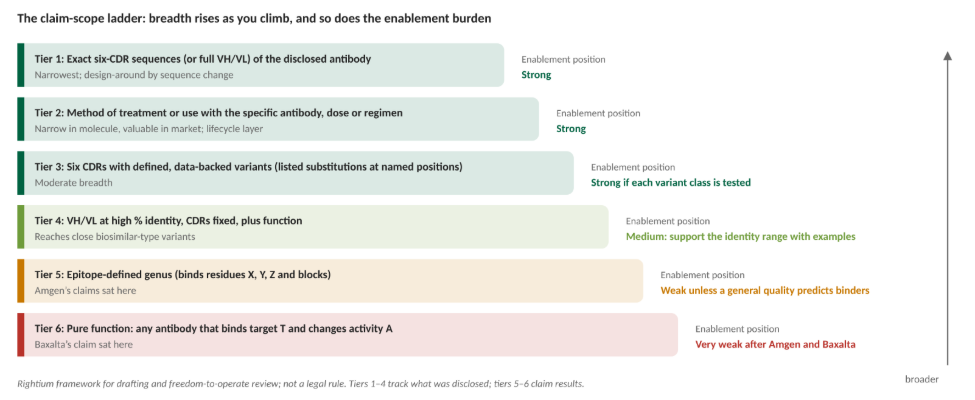
- Anchor on sequence. Claim the six CDRs and the full VH/VL of each lead, plus the encoding nucleic acids, host cells and manufacturing process. These claims cannot be challenged on Amgen grounds.
- Claim variants you have tested. Recite substitutions by position (for example, “CDR-H3 of SEQ ID NO: x with up to two substitutions selected from Table Y”) and put binding and potency data for each class in the specification. The tables are the enablement.
- Use identity ranges with care. Claims to VH/VL at 90–99% identity work best with the CDRs fixed, so the variation is confined to framework. Support the bottom of the range with real examples.
- Show a general quality if you have one. If structural data reveal a binding mode tied to identifiable sequence features, such as a conserved CDR-H3 motif that contacts named epitope residues, disclose it with the evidence. This is the “general quality running through the class” that Amgen said could justify a genus.
- Build value through use claims. Methods of treatment, dosing regimens, patient groups and formulations of the specific molecule protect the commercial product without an unbounded genus.
- Treat epitope and function claims as extras, not foundations. File them in continuations if the data mature. Do not rest a franchise on them.
The working test for any antibody claim: if a competitor brought you a new sequence, could your specification tell you, before you tested it, whether it falls inside your claim and works? If only the assay can tell you, the claim is claiming the assay’s future results.
8. Why this matters to industry now
8.1 Second movers and biosimilars
Amgen v. Sanofi is a charter for second movers. A company that finds its own antibody against a validated target, with a different sequence, cannot be shut out by a functional genus claim of the first mover. Praluent stayed on the market. Freedom-to-operate work therefore turns on sequence claims and their reasonable equivalents. A competitor’s epitope and function claims should be weighed for § 112 vulnerability as well as infringement.
8.2 AI-designed antibodies
Computational design now generates large numbers of antibody candidates quickly, which makes the Amgen question sharper. Easier screening does not change the analysis: the Court’s objection was to search without prediction, and generating more candidates faster is still search. The open question, not yet decided by any court, is whether a validated predictive model could serve as the “general quality” that links sequence to function across a claimed genus. If it can, it will need real-world validation data in the specification across the claimed range.
8.3 Valuation and diligence
In licensing and M&A, the value of an antibody patent estate tracks its sequence-defined and use claims. Epitope-only or function-only claims filed before 2023 should be treated as contingent assets. Post-Amgen they are vulnerable at the PTAB and in court, as Baxalta showed for a claim covering a blockbuster bispecific.
8.4 A diligence checklist
- How many independent claims define the antibody by sequence, and how many only by binding or function?
- For each genus claim, how many working examples are there, and how do they spread across the claimed scope (epitope coverage, sequence diversity)?
- Does the specification disclose a structural rule that predicts function, with data, or only a screening protocol?
- Are substitution and identity claims backed by tested variants at the limits of the range?
- Would the competitor’s molecule fall in only the functional claims? If so, how exposed are those claims to an Amgen or Baxalta challenge?
- Are there use, dosing and formulation claims tied to the commercial sequence?
The takeaway
An antibody is patentable as a molecule; a target is not patentable as a market. Amino acid sequences give certain, enforceable boundaries. Functional and epitope language gives the appearance of breadth, but breadth must be paid for with disclosure that predicts which sequences work. A generic method of making and screening antibodies yields an open-ended set of unpredictable results, so it cannot support a claim to all of them. Draft from the molecule outward, and claim only as far as your data can see.
Authorities and sources
- Amgen Inc. v. Sanofi, 598 U.S. 594 (2023), slip op. No. 21-757 (May 18, 2023).
- Amgen Inc. v. Sanofi, 987 F.3d 1080 (Fed. Cir. 2021); Amgen Inc. v. Sanofi, 872 F.3d 1367 (Fed. Cir. 2017).
- Baxalta Inc. v. Genentech, Inc., 81 F.4th 1362 (Fed. Cir. 2023); In re Xencor, Inc., No. 2024-1870 (Fed. Cir. Mar. 13, 2025); Juno Therapeutics, Inc. v. Kite Pharma, Inc., 10 F.4th 1330 (Fed. Cir. 2021).
- Ariad Pharms., Inc. v. Eli Lilly & Co., 598 F.3d 1336 (Fed. Cir. 2010) (en banc); In re Wands, 858 F.2d 731 (Fed. Cir. 1988); Brenner v. Manson, 383 U.S. 519 (1966).
- O’Reilly v. Morse, 56 U.S. (15 How.) 62 (1854); The Incandescent Lamp Patent, 159 U.S. 465 (1895); Holland Furniture Co. v. Perkins Glue Co., 277 U.S. 245 (1928); Wood v. Underhill, 46 U.S. (5 How.) 1 (1846).
- 35 U.S.C. § 112(a), (b), (f); USPTO, Guidelines for Assessing Enablement in Utility Applications and Patents in View of Amgen v. Sanofi, 89 Fed. Reg. 1563 (Jan. 10, 2024).
- US 8,829,165 B2 and US 8,859,741 B2 (Amgen); US 7,033,590 (Baxalta).
- KEGG DRUG D10557 (evolocumab) and D10335 (alirocumab): sequences, formulae and molecular weights.
Editorial note: The CDR boundaries, identity counts and substitution arithmetic are Rightium analysis, shown to illustrate the courts’ reasoning. Claim descriptions follow the Federal Circuit’s 2021 opinion. This article is analysis, not legal advice.
IP Research & Intelligence, Rightium